
Mastering Asymmetric Opportunities: How to Win Big with Minimal Risk
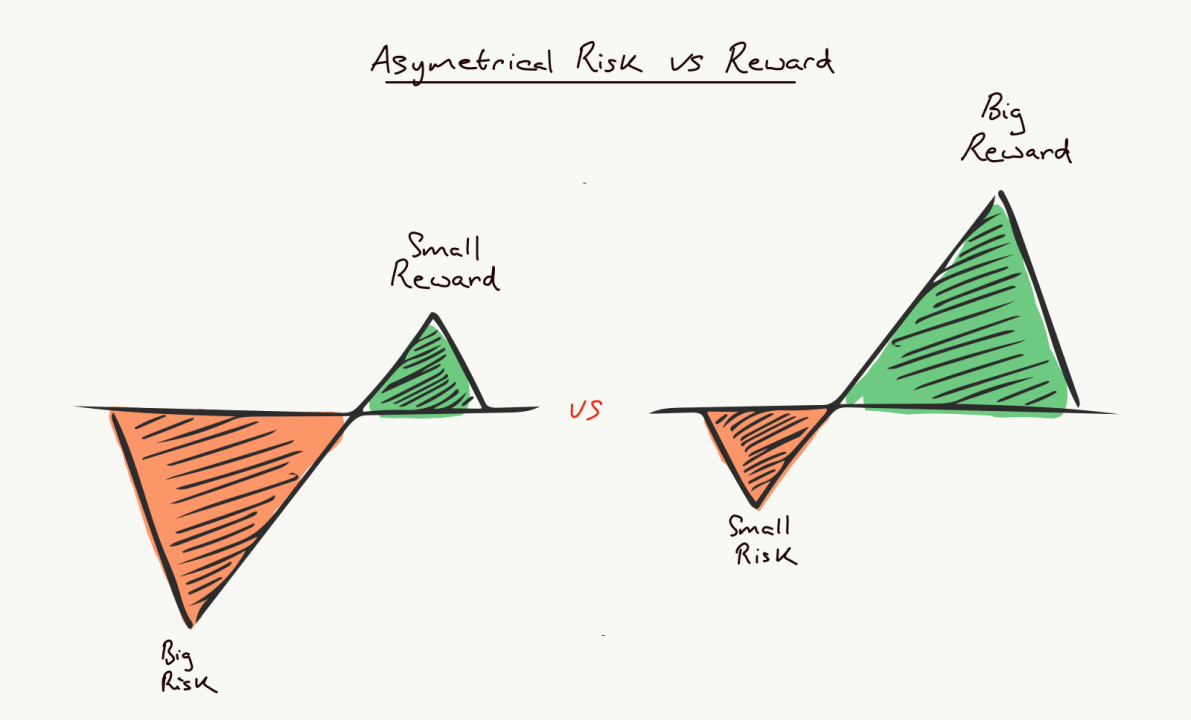
Asymmetrical opportunities refer to situations where the potential upside (reward) significantly outweighs the potential downside (risk)

Imagine you're at a carnival and have a chance to play a game.
You pay $1 to play.
If you win, you get $100. But the odds of winning are pretty low.
This is called an asymmetrical opportunity — a situation where the risk (losing $1) is small compared to the potential reward ($100).
Here’s a high-level breakdown of this framework:
Risk: The potential downside or what you can lose.
Reward: The potential upside or what you can gain.
Asymmetry: The imbalance between risk and reward, where the reward far exceeds the risk.
Goal: Making small, calculated investments or efforts that could lead to disproportionately large gains.
Now, let’s explore a different example.
Imagine you're considering investing in a startup.
The most you can lose is what you invest, say $1,000. However, if the startup succeeds, it might return 100 times your investment or more.
Your maximum loss is capped at $1,000, but there is no cap on the potential gain, which could be $100,000 or more.
The key characteristics here are:
Limited downside: The loss is limited and known in advance (e.g., the initial investment).
Unlimited upside: The gain has the potential to be many times the initial stake.
Probability and impact: The probability of winning might be low, but the impact of a win is so high that it makes the risk worthwhile.
Let’s dive deeper into this framework.
Why Should You Embrace Asymmetrical Opportunities
The beauty of asymmetrical opportunities is that they allow you to take calculated risks with limited downside.
This is critical because it frees you from the paralyzing fear of failure. When the cost of losing is minimal but the reward could be life-changing, the decision to "go for it" becomes much easier.
Consider the tech entrepreneurs of Silicon Valley.
Many of them embrace the 'fail fast' philosophy, which is fundamentally about continuously seeking asymmetrical bets in technology.
They understand that while many ventures will fail, the success of one breakthrough idea can outweigh dozens of unsuccessful ones.
It’s important to note, however, that the utility of this framework extends far beyond business or investment decisions. It applies to many areas of life where you need to weigh potential gains against manageable losses.
Examples of Asymmetric Bets
Investing in yourself (reading books, listening to podcasts, attending courses, etc.). By far the best investment you’ll ever make.
Writing a book
Starting a blog, podcast, or YouTube channel
Learning a new, in-demand skill
Learning a new language
Building relationships (I hate the term “networking”)
Investing in stocks
Investing in startups
Investing in real estate in emerging markets
Starting a side business
Creating a digital/software product
Volunteering for new projects at work (especially those that nobody else wants to touch)
Asking someone out
Investing in your health
Moving to a bigger city or country
How to Identify Asymmetrical Opportunities
1. Assess the downside rigorously
Start by evaluating what you have to lose. The downside should be limited and tolerable.
This could mean something as simple as time, a small amount of money, or even potential minor embarrassment.
If the loss is something you can easily recover from without long-term effects, you might be looking at an asymmetrical opportunity.
* * *
2. Understand the upside
Consider what you stand to gain.
Sometimes the benefits are not purely financial; they could include personal growth, skills, network expansion, or even just enjoyment. Weigh these potential benefits against the downside.
An opportunity with a potential for large-scale impact on your personal or professional life might be worth the risk.
* * *
3. Look for scalability
Opportunities that can scale, either by growing in profitability, impact, or personal significance, often present asymmetrical risks.
For example, starting a small blog or a YouTube channel requires minimal upfront investment but has the potential to reach a vast audience over time.
* * *
4. Seek out undervalued opportunities
Look for areas where the potential hasn't yet been recognized by others.
This could be a new market, a new trend, or even a new technology. Early adopters in these fields often reap significant rewards once these areas gain broader recognition.
* * *
5. Leverage information asymmetry
Sometimes, having specialized knowledge or information that is not widely available can create an asymmetrical opportunity. This could come from professional expertise or a unique personal experience.
Using this knowledge to make decisions can provide an edge that others may not have.
* * *
6. Experiment frequently
The more you try new things, the higher your chances of discovering an asymmetrical opportunity.
Look for low-cost experiments in particular. Where possible, pilot your ideas on a smaller scale before fully committing.
This could involve starting side projects, testing different business ideas, freelancing, trying new hobbies, or even starting a blog. The key is to start small with minimal investment and adjust based on feedback and outcomes.
Each experiment might cost you little but has the potential to lead to something much bigger.
* * *
7. Utilize feedback loops
Engage in activities where you can quickly get feedback and results. This allows you to adjust and iterate without significant losses.
Fast feedback loops help refine your approach to focusing more on opportunities with a higher chance of success.
* * *
8. Engage with a diverse range of people
This can provide insights into new trends, industries, or potential investments that you wouldn’t have discovered on your own.
People are gateways to unexplored avenues— and some of the best opportunities come from connections with others.
* * *
9. Leverage your time
Time can be an asset or a cost.
If an opportunity requires time but little to no money, consider what else you could do with that time. If there’s no better alternative, your investment of time could be considered low-risk.
* * *
10. Stay informed
Keep yourself updated with the latest trends, news, and shifts in technology and society.
The more informed you are, the better your chances of recognizing a valuable opportunity when it appears.
Common Pitfalls to Avoid When Assessing Asymmetrical Opportunities
1. Overestimating the likelihood of success
It's easy to get caught up in the excitement of a big payoff and start believing that success is more likely than it actually is. This can lead to making risky decisions based on overly optimistic expectations.
For example, if someone tells you about a "can't-miss" stock tip, you might invest without doing your own research, thinking the big win is a sure thing.
* * *
2. Underestimating the risk involved
Just as you might overestimate your chances of winning, you might not fully appreciate the risk you’re taking on.
Even small investments add up, and time, once spent, is gone forever.
It’s vital to genuinely assess what it means to lose in each scenario, considering not just financial costs but also time, emotional investment, and other opportunities you might miss.
* * *
3. Ignoring the opportunity cost
When you take one opportunity, you often give up the chance to pursue others. A common mistake is not considering what else you could do with the resources you're committing.
For instance, if you spend a lot of time chasing a small chance at a big win, you might miss out on surefire gains elsewhere.
It’s important to evaluate not just what you stand to gain or lose directly, but also what you're missing out on by choosing this path.
* * *
4. Letting emotions drive decisions
Excitement, fear, and other emotions can cloud judgment.
When assessing an asymmetric opportunity, it's important to stay objective and not let emotions dictate your choices.
People often get swept up in the thrill of a gamble, even when the rational decision would be to walk away.
* * *
5. Falling prey to confirmation bias
When you want an opportunity to be good, it's easy to filter out any evidence to the contrary unconsciously.
This confirmation bias can lead you to ignore glaring red flags about why an opportunity might actually be a bad idea.
Seeking objective advice or forcing yourself to consider the cons as thoroughly as the pros can help mitigate this.
* * *
6. Not setting a stop-loss point
Even in low-risk situations, things can go south.
Not having a predetermined point at which you’ll cut your losses can turn a small risk into a catastrophic one. Whether it’s a certain amount of money spent or time invested, decide in advance when you’ll walk away.
* * *
Always aim to balance enthusiasm with careful analysis, and remember to consider both the potential upsides and the downsides of any risky opportunity.
Questions to Ask When Evaluating Asymmetrical Opportunities
Here are some useful questions that can help you assess such opportunities more effectively:
What is the maximum potential reward?
Understand the best-case scenario. What can you gain from this opportunity? Is it financial profit, personal growth, professional advancement, or something else?
What is the realistic worst-case scenario?
Consider the possible losses. What could you lose if things don't work out? How severe would the impact be on your finances, time, or reputation?
How likely is it that the worst-case scenario will occur?
Assess the probability of facing the worst-case outcome. Is it a frequent occurrence in similar situations, or is it an unlikely event?
Can I afford the potential losses associated with this opportunity?
Evaluate whether you are financially and emotionally equipped to handle the potential downsides if they were to occur.
What is the likelihood of achieving the potential reward?
Estimate the chances of success. Are there statistics, historical data, or other factual bases that support a positive outcome?
What factors could influence the outcome of this opportunity?
Identify external and internal factors that could affect the success or failure of the opportunity. Consider market conditions, economic factors, competition, your own skills, and resources.
How does this opportunity align with my long-term goals and values?
Reflect on whether pursuing this opportunity fits with your broader life and career ambitions. Does it move you closer to where you ultimately want to be?
What are the opportunity costs of pursuing this opportunity?
Consider what else you could do with your resources (time, money, effort) if you decide against this opportunity. What other opportunities would you have to pass up?
What is the timeframe for potentially seeing a return on this opportunity?
Determine how long it might take to realize a reward. Will it be quick, or will it require a long-term commitment?
What exit strategies are available if the opportunity doesn't pan out as expected?
Plan for contingencies. What are your options if you need to back out or if you need to mitigate losses?
How unique is this opportunity?
Evaluate whether this opportunity is a rare find or if similar chances are likely to come around frequently. Does its rarity add to its value?
What additional information do I need to make a well-informed decision?
Identify any gaps in your knowledge that need to be filled before making a decision. How can you obtain this information?
How to Apply This Framework in Your Life
1. Evaluate your current opportunities
Look at the choices and opportunities currently available to you.
This could be projects at work, investment options, educational courses, or even personal relationships.
* * *
2. Evaluate the risk
Assess the downside of each opportunity. Ask:
What’s the worst that can happen?
How likely is this worst-case scenario?
Can I handle the consequences if the worst-case scenario occurs?
If the worst-case scenario is something you can live with or recover from quickly, you're likely looking at an asymmetrical opportunity.
* * *
3. Assess the potential rewards
After understanding the risks, shift your focus to the potential rewards. Consider:
What’s the best outcome that could result from this opportunity?
How can this benefit my career, finances, or personal growth?
Are these rewards significantly greater than the risks?
Sometimes, the upside isn’t just financial—it could be personal growth, a new skill, or an expanded network. These gains might be harder to quantify but can be equally valuable, if not more so.
* * *
4. Consider the likelihood of success
Analyze how likely it is that you will achieve the potential rewards.
This involves some research and a realistic assessment of the situation, including factors like market conditions, your skills, and timing.
* * *
5. Make a decision
With a clear understanding of the risks, rewards, and likelihood of success, decide whether to pursue the opportunity.
The key to asymmetric bets is choosing paths where the potential high rewards justify the risks, especially when the chances of success are reasonable.
* * *
6. Plan and execute
If you decide to pursue the opportunity, plan your approach carefully.
Consider what steps you need to take, the resources required, and how you will manage the risks involved.
If possible, test the waters before committing fully.
* * *
7. Monitor and adapt
Once you’re in motion, keep a close watch on how things are unfolding. What’s working? What isn’t?
Be ready to adapt your strategies as needed.
This could mean cutting losses when it's clear that the expected upside is no longer achievable, or doubling down if the opportunity proves even more promising than expected.
* * *
8. Learn and iterate
Regardless of the outcome, take time to reflect on what you’ve learned from the process.
Embrace challenges and failures as opportunities to learn and grow.
Each experience provides valuable insights that can improve your ability to identify and capitalize on asymmetric opportunities in the future.
* * *
Remember, sometimes the greatest risk lies in not taking one at all.
The key is not just in finding them but also in having the courage to act when they do appear.
Additional Resources
Recommended Books
Antifragile, by Nassim Nicholas Taleb
The Black Swan, by Nassim Nicholas Taleb
Fooled by Randomness, by Nassim Nicholas Taleb
Skin in the Game, by Nassim Nicholas Taleb
Thinking in Bets, by Annie Duke
Same as Ever, by Morgan Housel
Let’s continue the conversation!
Can you think of a time when you passed on an opportunity because the risk seemed too high, but in hindsight, the potential reward was much greater?