
Chapter 2: The Barbell Strategy
Why your career needs both safety and risk

For a decade of my life, before I sat behind a screen for a living, I made my living on a football pitch.
When you’re a young player desperate to prove yourself, you have a natural instinct to look busy. You jog everywhere. You chase the ball into corners where you have no business being. You want the coach to see you sweating, because sweat looks like work.
But when you make it to the professional level, you learn something counterintuitive: activity is not achievement.
Watch an elite player — Messi, Haaland, Mbappé. They spend most of the match walking. Almost static. Scanning the field, conserving energy, ensuring they’re never caught out of position.
They look like they’re doing nothing.
Then the moment comes. A loose ball. A broken defensive line. A passing lane opens for half a second.
They explode.
Zero to maximum velocity so fast it looks like time skipped. They take the risk that changes the game. Then they’re back to walking.
The amateur player stays in the middle. They jog everywhere: not slow enough to rest, not fast enough to be dangerous. Too tired to sprint when the moment comes, but not rested enough to recover between moments.
They’re efficiently mediocre.
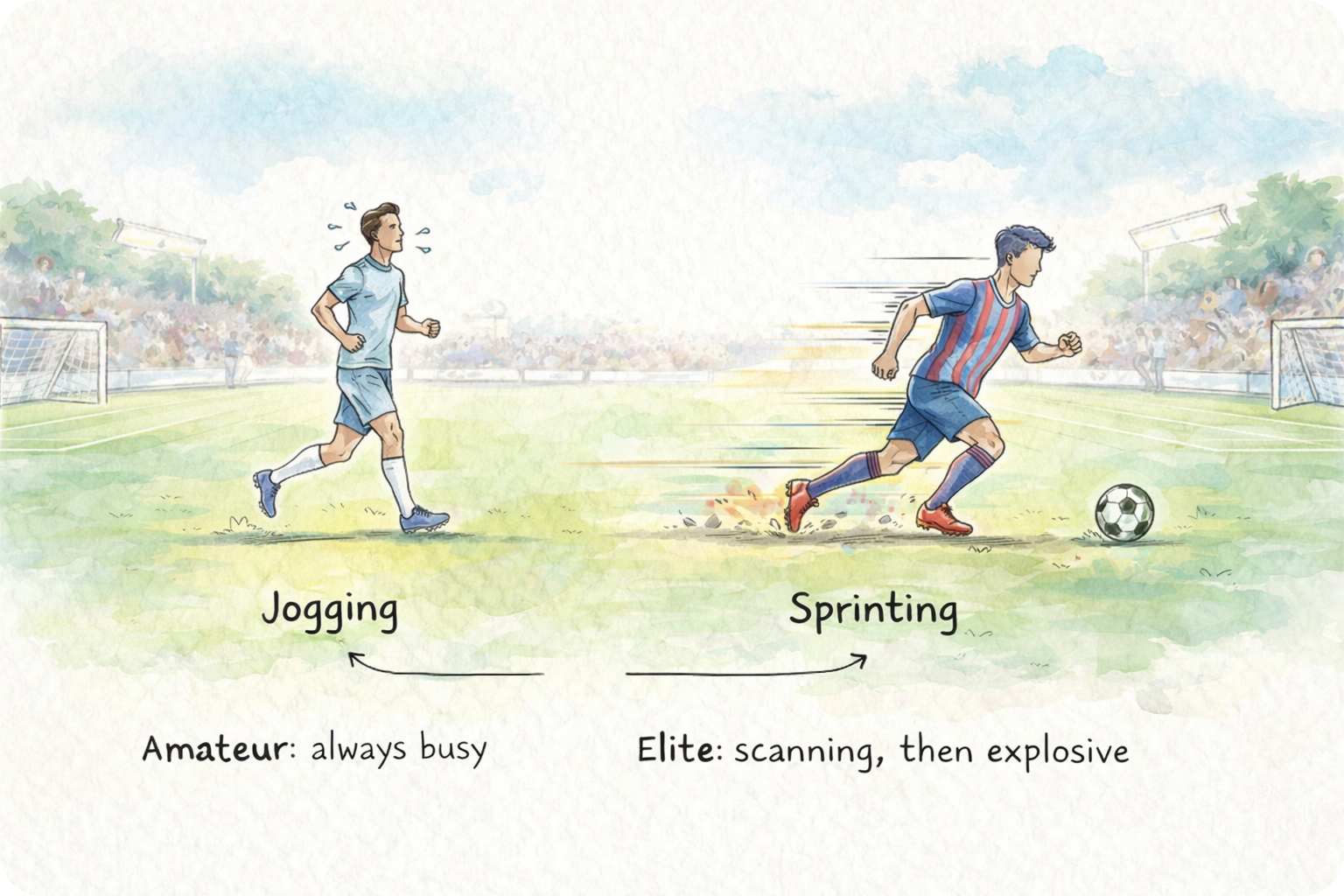
Most of us live our careers the same way.
Moderately stressed at jobs we moderately tolerate. Taking on enough responsibility to be anxious, but not enough risk to break free. Always moving, always busy, but somehow never rested and never explosive.
We’re jogging when we should be walking or sprinting.
The Shape of Survival
Nassim Taleb uses the image of a weightlifting barbell to explain this concept.1
Picture a barbell in a gym. It has heavy plates on the far left. It has heavy plates on the far right. In the middle, there’s nothing but a thin bar connecting them.
This shape, heavy at the extremes, empty in the center, turned out to be a blueprint for surviving uncertainty.
The left side is your safety. Your fortress. The boring, unglamorous stuff that ensures you can’t be killed. Cash in the bank. A stable skill that always has demand. Low overhead that means you’re not forced to optimize for maximum income just to survive.
The right side is your risk. Your lottery tickets. The wild experiments with potentially massive upside but high probability of failure. The side project. The moonshot. The creative work that might not pay off.
The middle is where most people live. And it’s the most dangerous place to be: moderate risk with capped upside.
It’s the job that’s stressful enough to keep you anxious but offers no equity. It’s the investment that could lose half its value but will never 10x. It’s the career move that feels safe but leaves you exposed.
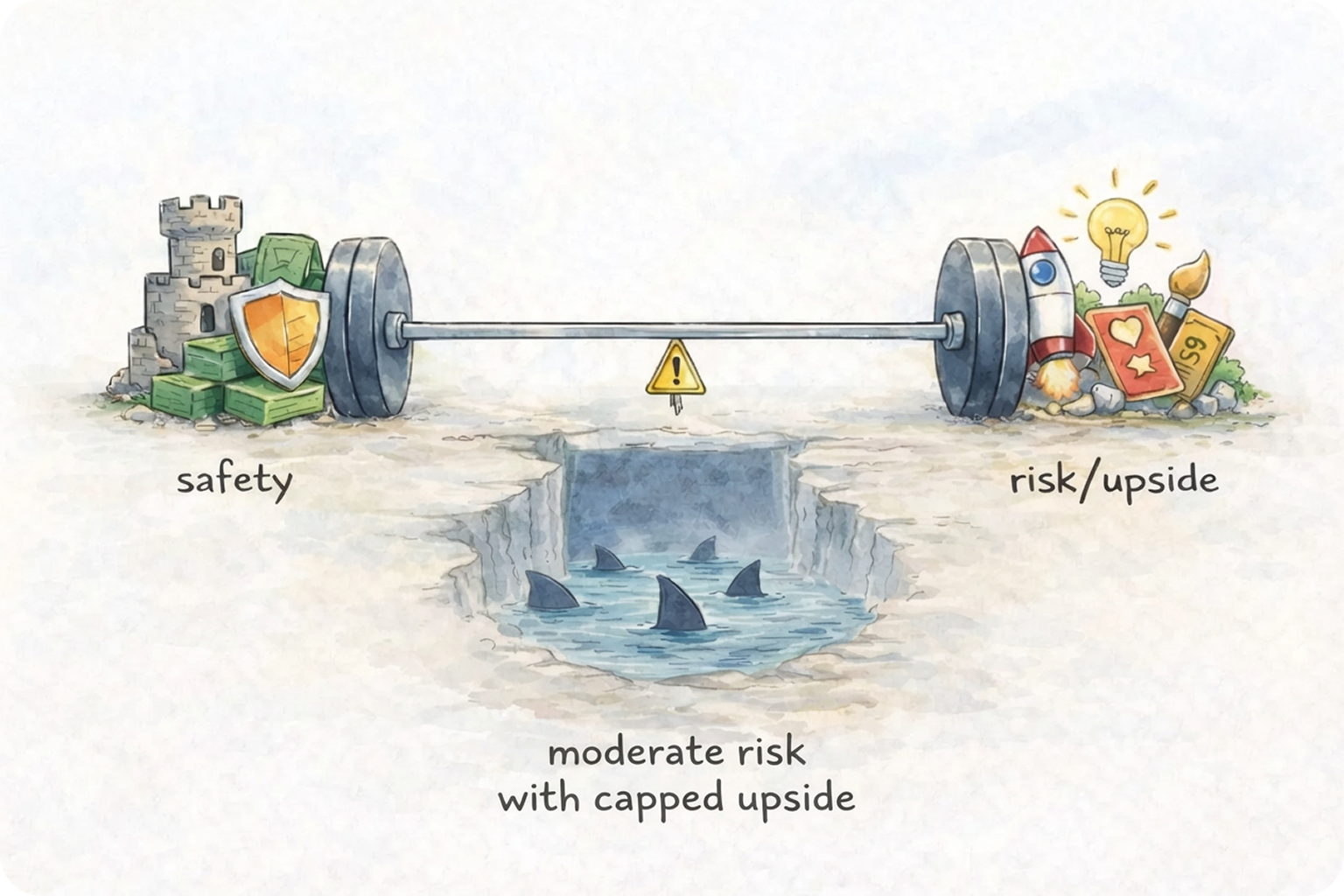
When Taleb talks about the barbell strategy, he calls it “the combination of aggressiveness plus paranoia”.2
You need the paranoia — the heavy, boring safety on the left — to last long enough to be aggressive. You need complete protection on the downside so you can afford to be completely wild on the upside.
Here’s the part that’s hard to accept: most of what you try will fail.
The middle ground lets us avoid this reality. We can tell ourselves we’re making steady progress, climbing a ladder, building toward something. The moderate strategy promises moderate returns, and moderate feels achievable.
The barbell forces a different reckoning. Some of your eggs are in an unbreakable safe. The rest you’re throwing off a cliff to see if any grow wings. And most won’t grow wings.
That’s the bargain.
The person with a barbell strategy looks unstable. They have a boring day job and a weird side project. Their resume is messy. They don’t fit cleanly into a category.
The person in the middle looks professional. Committed. All in.
Until the environment shifts and they have nowhere to go.
The Poet and the Banker
T.S. Eliot wrote some of the most revolutionary poetry of the 20th century. The Waste Land. Four Quartets. The Love Song of J. Alfred Prufrock. Works that redefined what poetry could be.
He did all of this while working as a banker.
From 1917 to 1925, Eliot wore a suit every day and worked at Lloyds Bank in London.3 He checked foreign accounts and handled colonial settlements. Boring, bureaucratic work that had nothing to do with poetry.
Most people see this as a compromise. The struggling artist forced to pay bills. The creative genius trapped in a cubicle.
I think they’re missing the point.
The job at Lloyds gave Eliot something more valuable than money. It gave him freedom.
Because he didn’t need his poetry to pay rent, he didn’t need to make his poetry commercial. He didn’t need to please editors or chase trends or write crowd-pleasers. He could be as weird and experimental as he wanted. He could spend five years on a single poem. He could write fragmented, difficult work that confused half his readers.
The boring job was the heavy left weight: the safety. The revolutionary poetry was the heavy right weight: the risk. Nothing in the middle.
Here’s the psychological insight that matters: desperation kills creativity.
If Eliot had quit banking to write poetry full-time, he would have needed his poetry to pay bills immediately. That pressure would have forced him to write what sells, not what matters. It would have pushed him toward the middle — poetry that’s weird enough to feel artistic but commercial enough to pay rent.
Instead, Eliot built a barbell. Complete safety on one end. Complete creative freedom on the other.
This pattern shows up more often than you’d think.
William Carlos Williams was a doctor. Wallace Stevens worked in insurance. Kurt Vonnegut sold Saabs. They didn’t do this because they couldn’t make it as full-time creators. They did it because steady income let them take risks in their art that full-time creators couldn’t afford.
You can only take big risks when you know you can’t die.
Where the Barbell Doesn’t Work
Before you barbell everything in your life, understand something important: this strategy has a domain.
It works in areas where you want uncapped upside and can afford to fail: investments, careers, creative work. Places where one big win can compensate for many small losses.
It doesn’t work everywhere.
Your health needs consistency, not extremes. Starving and then binging is an eating disorder, not a strategy. Your body doesn’t have asymmetric payoffs. It needs steadiness.
Your relationships need stability, not the rollercoaster of extreme fighting alternating with extreme passion. That’s not romance. That’s dysfunction masquerading as intensity.
Your ethics can’t be situational — extremely honest here, extremely dishonest there — without destroying trust entirely. Trust, once broken, doesn’t have upside. It just has loss.
The barbell is a specific tool for managing uncertainty in domains with asymmetric payoffs. Use it wrong and you just create chaos.
Most of life should be lived in the middle.
There’s enormous dignity in an ordinary life: moderate temperament, moderate diet, moderate political views. The world needs people who show up consistently, who don’t swing between extremes, who provide the steady foundation that allows others to take risks.
But when it comes to career, money, and creative work, domains where the future is genuinely uncertain and the payoffs are genuinely asymmetric, the middle ground is more dangerous than it looks.
What to Avoid: The “Mush”
The enemy of the barbell is what I call The Mush.
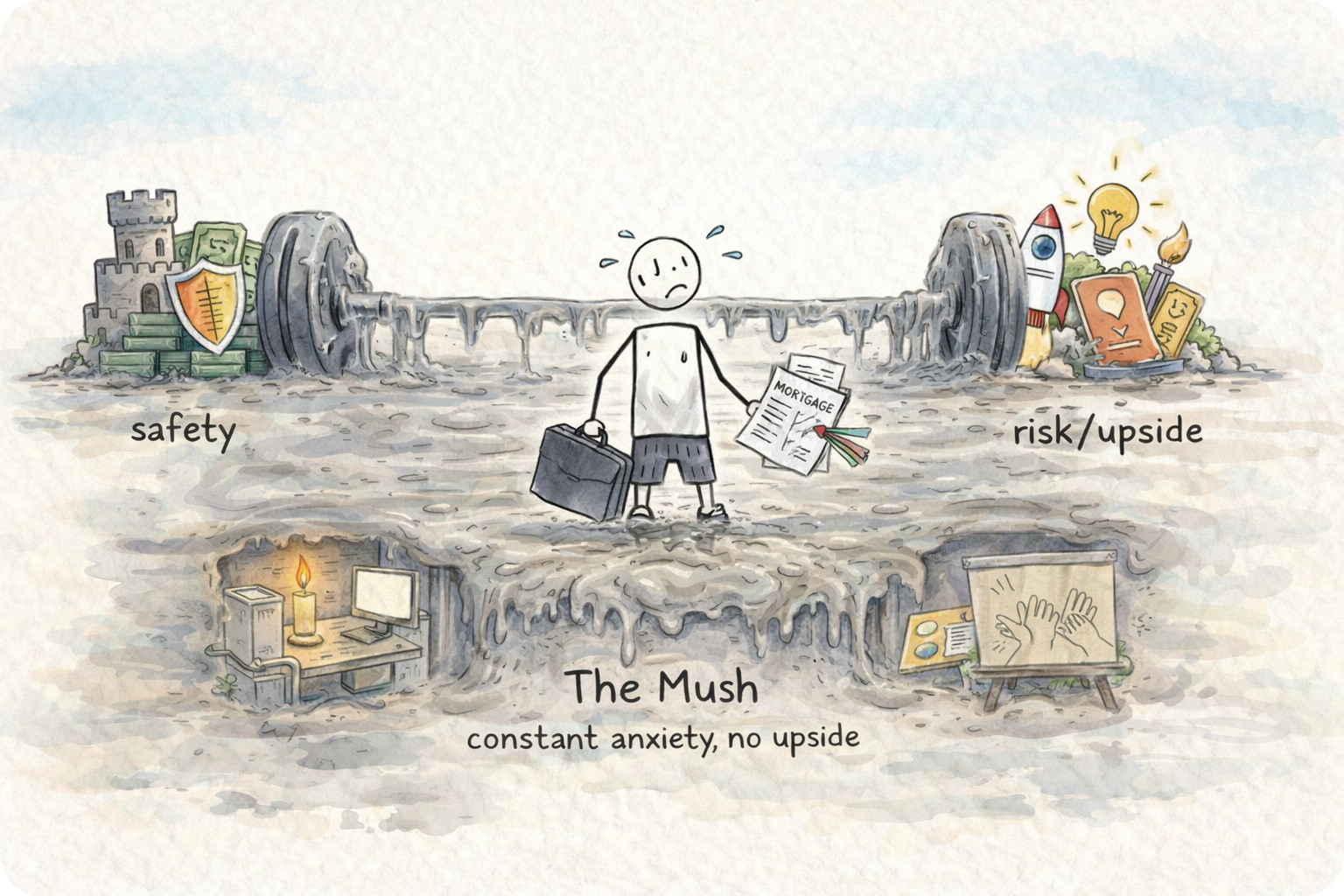
The Mush happens when you mix safety and risk until you get the worst of both worlds.
The career mush looks like high stress and demanding hours with no equity or autonomy. You’re renting your time to build someone else’s asset while burning yourself out. You have the downside of exhaustion without the upside of ownership.
The financial mush is that expensive house that stretches your budget. It feels like an investment, but it destroys your liquidity and forces you to keep working a job you hate. You’re trapped by what you own.
The creative mush is trying to please everyone slightly rather than a few people intensely. Your work ends up too weird to be commercial and too safe to be interesting. You’ve positioned yourself in the awkward middle where nobody feels strongly about what you’re doing.
The diagnostic is simple: If you’re constantly anxious but rarely excited, you’re in The Mush. You’re jogging.
What This Looks Like in Practice
First: Build the fortress.
You start by building the heavy left weight: your safety.
This means six to twelve months of expenses in boring cash. Not invested. Not in crypto. Boring money that will be there when everything else crashes.
It means having a stable routine or a bread-and-butter skill that keeps the lights on without draining your soul.
It means keeping your overhead low enough that you’re not forced to optimize for maximum income just to survive.
This part is unglamorous. Everyone wants to skip it. But this is what gives you permission to be aggressive.
Second: Add the moonshots.
Once the fortress is built, you add the heavy right weight. You find one area where you can take a real risk. Something with low cost if it fails (usually just time), but massive upside if it works.
You write the book that might not sell.
You build the app that might not get users.
You learn the skill that might never pay off.
The key word is one. Maybe two. Not twelve. You’re not dabbling. You’re making a genuine attempt. But you’re doing it from a position of safety that lets you be patient.
Third: Keep the middle empty.
Then comes the hard part: you have to keep the middle empty. You stop doing things that are “kind of” risky and “kind of” rewarding.
The investment that could lose half but will never double.
The client that demands too much for too little.
The project that drains time without building toward anything.
These feel like progress, but they’re actually friction that prevents you from being either truly safe or truly aggressive.
This is harder than it sounds because we’re conditioned to think that success comes from addition. But the barbell strategy reveals a different truth: sometimes the path forward requires subtraction.
The middle ground isn’t neutral territory you can ignore. It’s active friction.
Look at your life and ask:
Where am I taking moderate risk with capped upside? (Working overtime for a 3% raise, for example.)
Is my safety truly safe? (Can I survive six months without income?)
The goal isn’t to be Messi or T.S. Eliot. The goal is to ensure your need for stability isn’t preventing you from placing the few small bets that actually matter.
The Pattern You Can’t Unsee
I still watch football when I get the chance. Local games. Professional matches. Kids playing in parks.
And I see it everywhere now.
The players who jog. The ones in constant motion, never quite rested and never quite dangerous. They look busy. They look committed. They look like they’re contributing.
But they’re not walking when they should conserve energy. And they’re not sprinting when the moment comes.
Once you see the pattern, you can’t unsee it.
It’s not just in football. It’s in how people structure their careers, their finances, their creative work. Most people live in the middle: not safe enough to weather chaos, not aggressive enough to capture opportunity.
They feel productive. They feel like they’re making progress. But they’re jogging through life, and the world doesn’t reward jogging.
The barbell looks unstable from the outside. It looks like you’re not fully committed to anything. Like you’re hedging your bets or refusing to choose.
But maybe that’s the point.
Maybe the people who look most committed are actually the most trapped. Maybe looking unstable is the price of actually being stable. Maybe the person who admits they don’t know which specific bet will pay off is more honest (and ultimately more resilient) than the person who pretends they’ve figured it all out.
You can’t predict which skills will matter in five years. You can’t know which industries will collapse or which opportunities will emerge. The future is genuinely uncertain, and anyone who tells you otherwise is either lying or delusional.
But you can build a life where it doesn’t matter what happens. Safe enough that bad luck can’t kill you. Aggressive enough that good luck can change everything.
The amateur jogs through the entire match, afraid to stop moving, afraid to look lazy, desperate to prove they’re contributing. They end up exhausted with nothing to show for it.
The professional understands something the amateur doesn’t:
The game isn’t won by constant motion. It’s won by knowing when to do nothing and when to do everything.
By having enough energy left when the moment arrives. By being in the right place, fully rested, when opportunity breaks through the defense.
And maybe most importantly: by accepting that you won’t always know which moment is the right one until after it’s already passed.
What’s Next: Via Negativa

Antifragility: Nassim Taleb defines the barbell as a dual strategy of avoiding the middle to stay resilient to shocks while retaining upside. See: Taleb, N. N. (2012). Antifragile: Things That Gain from Disorder. Random House.
Aggressiveness Plus Paranoia: The psychological necessity of combining extreme downside protection with extreme upside venture to benefit from disorder. See: Taleb, N. N. (2012). Antifragile: Things That Gain from Disorder. Random House.
T.S. Eliot at Lloyds Bank: For biographical details on Eliot’s tenure as a colonial accounts clerk and how it provided the stability for his poetic breakthroughs, see: Gordon, L. (1998). T.S. Eliot: An Imperfect Life. W. W. Norton & Company.
That’s a great take on optionality