
Chapter 6: Hormesis — Why Comfort Makes You Fragile
How we're engineering ourselves into fragility, and the case for voluntary discomfort.

In the early 1990s, scientists built a cathedral of glass in the Arizona desert.
They called it Biosphere 2.
It was meant to be a perfect, self-sustaining replica of Earth’s ecosystem. A hermetically sealed world with its own ocean, rainforest, savanna, and wetlands. They pumped in purified air. They filtered the water. They optimized the light. It was an environment designed for life to flourish without interference.
But then a strange phenomenon occurred.
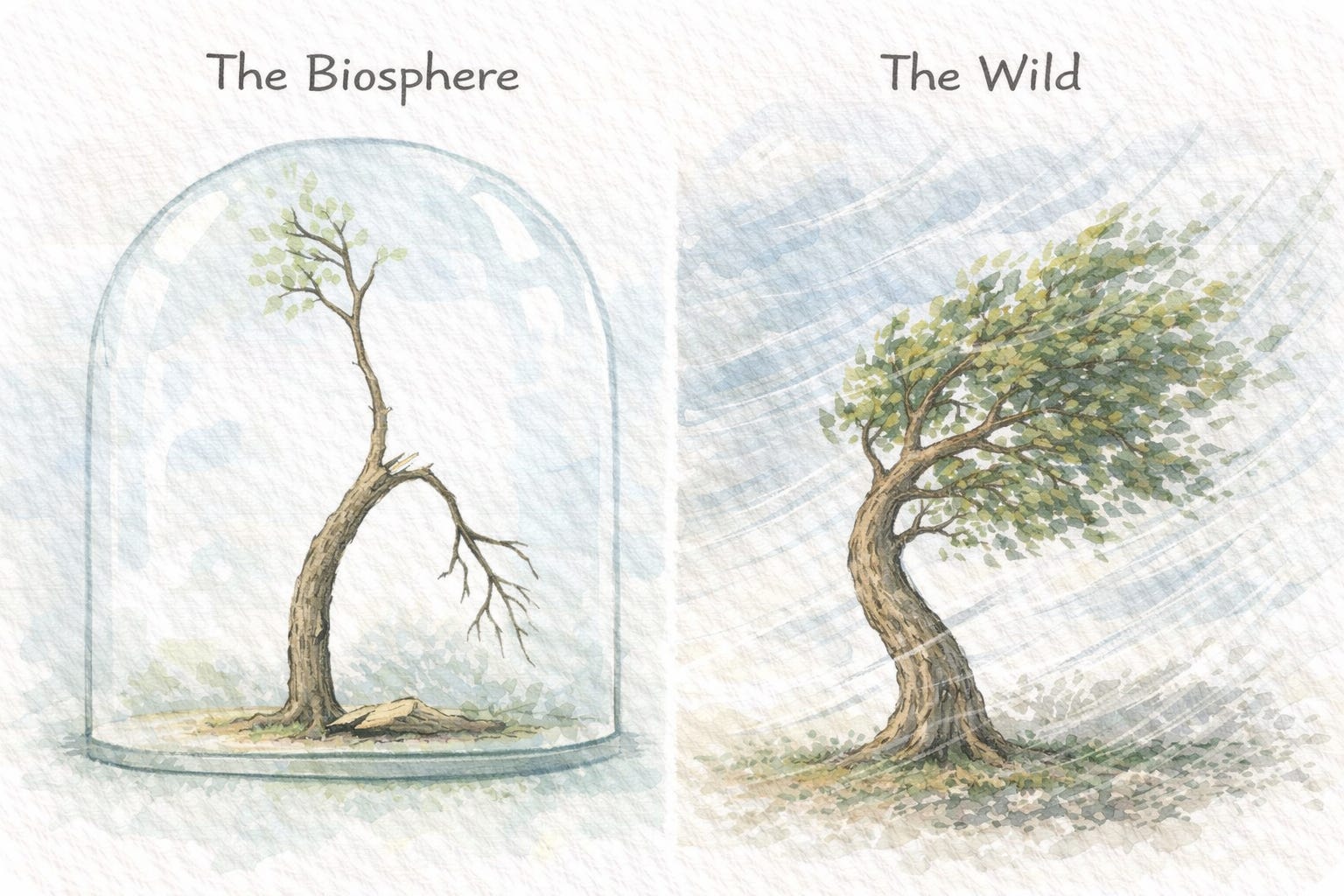
The trees grew rapidly, faster than they did in the wild. But before they could reach maturity, they would simply topple over. Entire limbs would snap under their own weight.
The scientists were baffled. The soil was perfect. The nutrients were optimized. The light was ideal. Why were the trees so weak?
They eventually found the culprit: The wind.1
In the wild, wind is a stressor. It pushes against the tree. It threatens to blow it over. But the tree responds to this stress by developing “reaction wood”: dense, fibrous tissue that reinforces the structure. The constant swaying signals the root system to dig deeper and the trunk to grow tougher.
Inside the Biosphere, the air was still. The trees had never been stressed, so they had never strengthened. They grew tall, fast, and fragile.
The perfect environment turned out to be a death sentence.
The Gymnasium of Stress
During my years as a professional footballer, I learned something about training that took years to understand.
The sessions that felt good — easy drills, light jogging, comfortable routines — produced almost nothing. My body stayed the same. My performance plateaued.
The sessions that felt hard — sprints that burned my lungs, weight training that left my muscles trembling, endurance training that pushed me to the brink of collapse — those were different. I’d leave exhausted, sometimes discouraged. But a week later, I could do things I couldn’t do before.
My coaches called it overload. You had to stress the system beyond its current capacity. Then you rested. Then the system came back stronger.
What I didn’t realize then was that this principle extended far beyond football. It explains why the Biosphere trees failed. It explains why we stop learning when we stop struggling.
Scientists call this Hormesis.2
It comes from the Greek word hórmēsis, meaning “rapid motion” or “eagerness.” In toxicology, it refers to a phenomenon where a substance that is lethal in high doses is actually beneficial in small doses. A little bit of poison wakes the body up. It triggers a cellular defense response that ends up making the organism stronger than it was before the exposure.
We see this everywhere once we look for it:
Exercise is hormesis. You are literally tearing your muscle fibers (trauma) so they rebuild thicker.
Vaccines are hormesis. You introduce a deactivated threat so the immune system learns to fight.
Calluses are hormesis. Friction damages the skin; the skin grows back tougher.
The logic is universal: To be safe, you must be slightly endangered.3
The Comfort Paradox
And yet, we are doing the opposite. We are building Biospheres for ourselves.
Modern life is a conspiracy to eliminate the very friction that makes us strong. We have temperature-controlled rooms. We have food delivered to our doors. We have algorithms that curate information so we never have to read an opinion that upsets us.
We view stress as a design flaw. If something is difficult, we assume it’s broken. If a process is physically demanding, we invent a machine to do it. If a conversation is awkward, we send a text to avoid it.
Our stated goal is comfort. But biology has a different goal: adaptation.
And as we just learned, adaptation has a strict rule: It only happens in response to a threat.
By removing the “wind” from our lives (i.e. the physical exertion, the social friction, the intellectual challenges) we’re not preserving ourselves. We are atrophying. We are creating a life that feels safe in the short term but is terrifyingly fragile in the long term.
We are growing tall, fast, and weak.
The Dose Makes the Poison
It’s important to understand the math here, because it distinguishes hormesis from simple abuse.
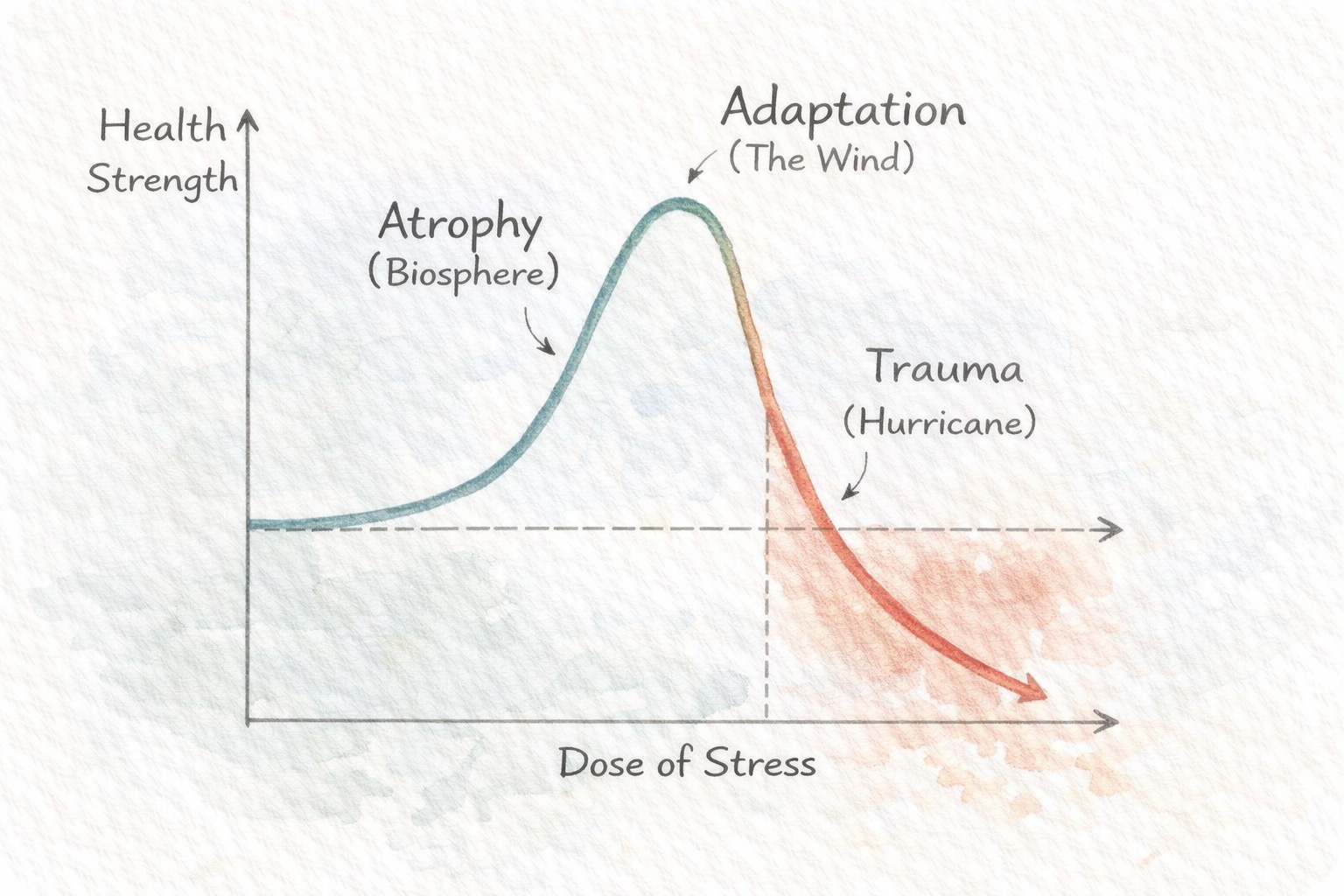
Imagine a curve.
Zero Stress: The Biosphere tree. Atrophy. Fragility.
Extreme Stress: A hurricane. The tree snaps. Trauma. Death.
The Sweet Spot: A strong wind. The tree bends, cracks slightly, and rebuilds stronger.
Most people live their lives at the extremes.
They oscillate between the Zero Stress of a sedentary, comfort-addicted routine and the Extreme Stress of burnout, panic, and crisis. They’re either on the couch or in the hospital.
The antifragile life is lived in the middle. It seeks out the “Goldilocks” zone of stress. Enough to hurt, but not enough to kill.
The Psychological Immune System
We understand this with muscles, but we forget it with our minds.
In the design world, we talk about “frictionless experiences.” We want users to flow through an app without thinking. But I’ve noticed something about junior designers who have only ever worked in “optimized” environments with clear design systems and helpful managers.
When they encounter a vague client or a messy problem, they collapse. They panic. They haven’t built the “reaction wood” of navigating ambiguity.
Contrast them with the designer who came up through a chaotic agency, who had to pitch ideas to angry clients, who had to ship products with broken tools. They are unflappable. The chaos is just another Tuesday to them.
We see this in parenting, too. We try to clear the path for our children. We solve their problems, mediate their conflicts, and shield them from disappointment. We think we’re protecting them.
We are actually denying them the wind.
Jonathan Haidt talks about this in The Coddling of the American Mind.4 By removing “safe” risks from childhood (i.e. unsupervised play, minor conflicts, physical danger), we have created a generation that is terrifyingly fragile to the inevitable hardships of adulthood.
If you’re never offended, you never learn to construct an argument.
If you never fail, you never learn to pivot.
If you never feel social anxiety, you never learn to read a room.
Safety is not the absence of threat. Safety is the presence of adaptation.
Acute vs. Chronic
There is a critical distinction that saves this principle from becoming “hustle culture” propaganda.
Hormesis relies on acute stress, not chronic stress.
Acute stress is a cold shower. A heavy deadlift session. A difficult public speech. It is intense, brief, and followed by recovery. This signals growth.
Chronic stress is a bad boss. A toxic relationship. Sleep deprivation. A low-level hum of anxiety that never stops. This signals decay.
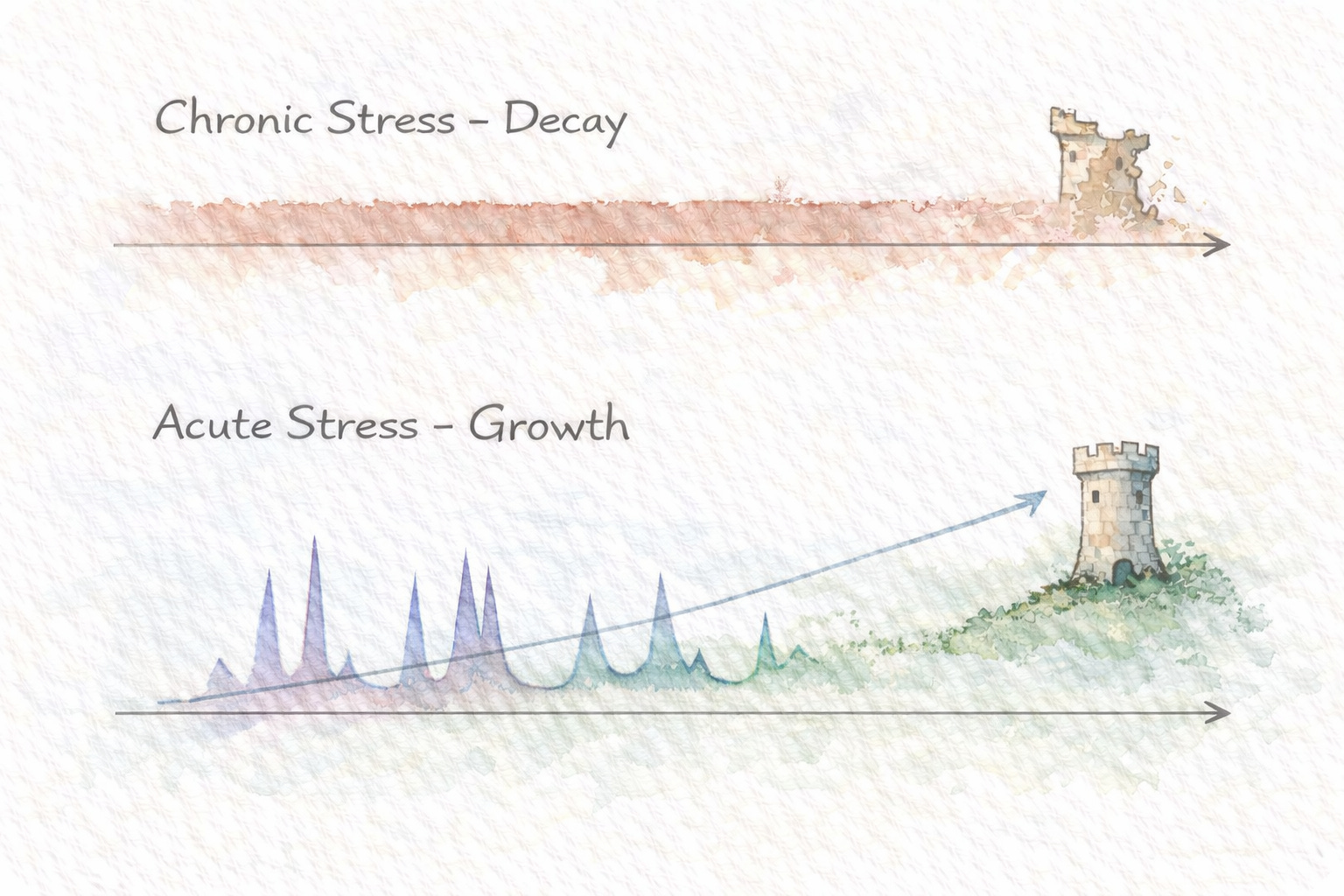
This is where the connection to our last chapter matters. Slack is the recovery mechanism for Hormesis. You cannot get stronger from the acute stress of the wind if your calendar is filled with the chronic stress of busywork.
The Biosphere trees didn’t need a permanent hurricane. They needed gusts.
Our mistake is that we have filled our lives with chronic, low-level stress (email, traffic, news, debt) and removed the acute, high-level stress (physical exertion, deep intellectual challenge, conquering fear).
We’re slowly eroding when we should be sharply stressing and then recovering.
Injecting the Poison: The Action Plan
So, how do we apply this? We stop avoiding friction and start engineering it. We practice Voluntary Discomfort.
1. Physical Hormesis
We know this one. Lift heavy things. Get out of breath. Expose yourself to heat (saunas) and cold (showers).
But don’t just do it for the “fitness.” Do it to remind your nervous system that it can survive shock. When you step into a freezing shower, your brain screams panic. When you stay in anyway, you’re training your mind to override the panic signal. That transfers to the boardroom.
2. Intellectual Hormesis
Read things that make you angry.
Most of us curate our information diet to reinforce what we already believe. This creates intellectual atrophy. Our arguments become brittle because they’ve never been tested.
Find the smartest person who disagrees with you and read their best work. Feel the blood pressure rise. Feel the confusion. That is your brain tearing its fibers. When you recover, your worldview will be more nuanced and more robust.
3. Professional Hormesis
Say yes to the project you are 20% unqualified for.
If you know exactly how to do your job, you’re in the atrophy zone. You’re a tree in a glass dome. You need the project that makes you wake up at 3 AM wondering if you can pull it off.
That fear is the wind.
The Gift of Resistance
I used to assume that people with ‘easy’ lives had the advantage. The trust fund kids. The ones who fell into perfect jobs. The ones who never seemed to struggle.
I know better now.
I realize that a life without resistance is a life without reaction wood. When the storm comes (and the storm always comes) they will be the first to fall.
The Stoic philosopher Seneca said, “I judge you unfortunate because you have never lived through misfortune. You have passed through life without an opponent—no one can ever know what you are capable of, not even you.”5
We spend so much energy trying to flatten the mountains in our path. We dream of a life that is downhill all the way.
But the friction isn’t the obstacle. The friction is the point.
Don’t pray for the glass dome.
Pray for the wind.
What’s Next

For a detailed analysis of why “perfect” conditions led to the structural failure of trees, see the BBC Future report on how Biosphere 2 changed our understanding of Earth.
Mattson, M. P. (2008). Hormesis defined. Ageing Research Reviews.
Taleb, N. N. (2012). Antifragile: Things That Gain from Disorder. Random House.
Haidt, J., & Lukianoff, G. (2018). The Coddling of the American Mind: How Good Intentions and Bad Ideas Are Setting Up a Generation for Failure. Penguin Press.
Seneca, Lucius Annaeus. Letters from a Stoic.
The gymnasium metaphor here is perfect - it's literally where we go to voluntarily subject ourselves to controlled stress. What strikes me about modern gym culture though is how we've started to optimize away the very discomfort that creates adaptation. Pre-workout supplements to mask fatigue, perfect climate control, even machines that isolate muscles so we don't have to struggle with balance. We're building Biosphere 2 versions of gyms. The old-school gymnasiums understood something we're forgetting: the struggle itself was the point, not just the outcome.