
The Antifragile Individual: How to Thrive in the AI Age and Beyond
What to focus on when you can't predict what's coming

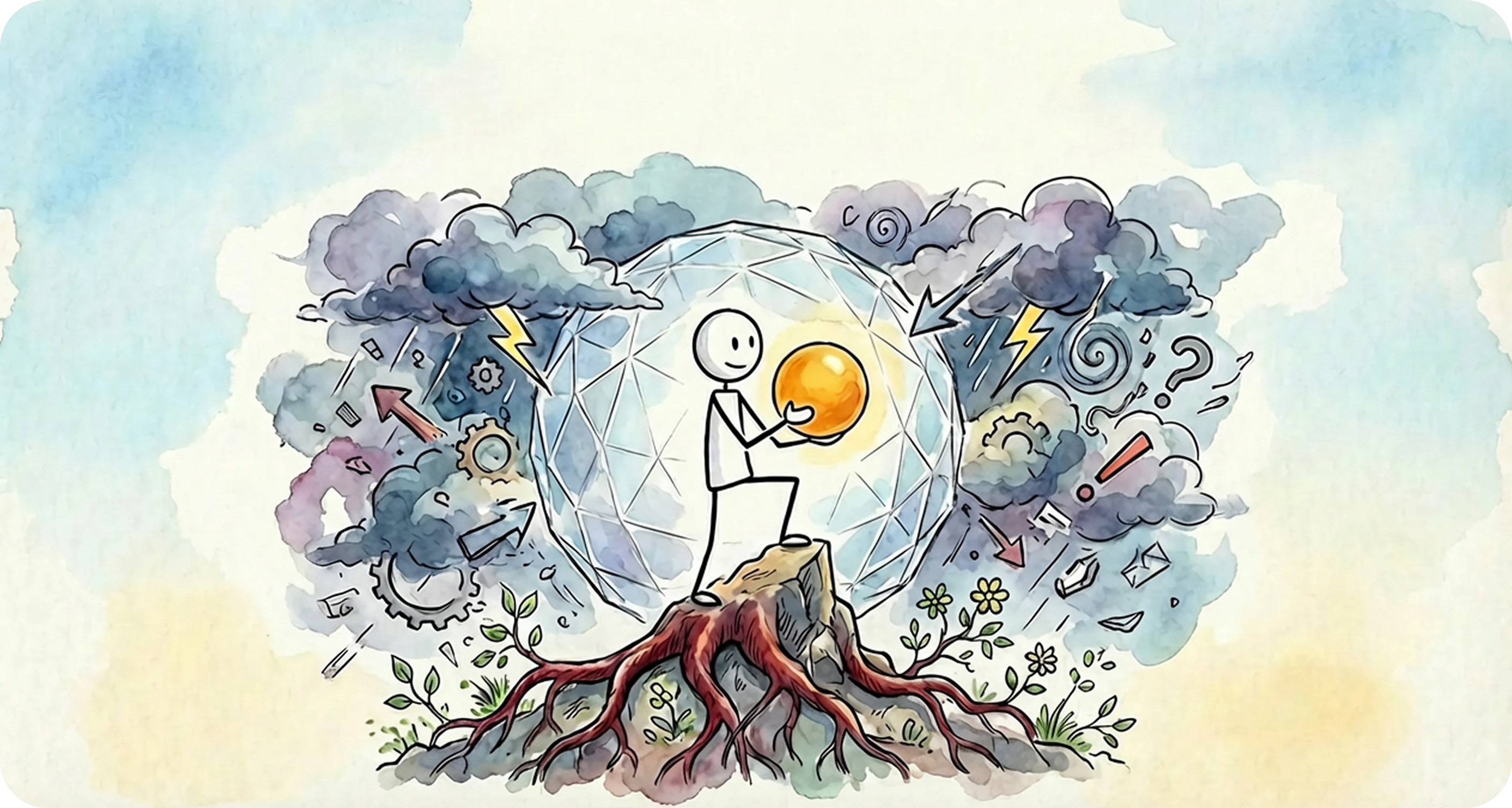
I’m a product designer in an industry that changes every time an algorithm updates.
I spend my days in Figma and Linear, working closely with product managers and engineers to ship software for a market that looks nothing like it did two years ago.
And if I’m being honest, the tools I use today might be doing my job for me two years from now.
Can you resonate?
Well, this isn’t just a problem for tech workers.
If you earn your living with your mind — whether you analyze spreadsheets, write legal briefs, manage marketing campaigns, or build roadmaps — you’re standing on the same shifting ground.
You feel a hum of anxiety in the background.
You feel it when you open LinkedIn in the morning and see a new tool you supposedly need to master “before it’s too late.” You feel it you when you realize that no matter how fast you run, the goalposts seem to move further away.
And the hardest part is that you did everything right.
You followed the script. You were the “good student.” You picked a sensible niche. You spent years mastering the nuances of your craft — memorizing the shortcuts, learning the jargon, understanding the hidden rules. You did exactly what the world told you to do to be safe.
And now, you open your laptop and see an AI doing 80% of that work in seconds.
You understand that competence is no longer a shield. The skills that got you promoted three years ago might be the very things that make you obsolete three years from now.
It is exhausting.
It turns out that specialization — the very thing we were taught was the path to safety — has become a trap.
The Rule That Stopped Working
To understand why we feel this way, we have to look back to 1776.
That year, Adam Smith wrote The Wealth of Nations. In the first chapter, he described a pin factory. He observed that one man working alone could make maybe one pin a day. But if you divided the labor — one man draws the wire, another straightens it, a third cuts it — ten men could make 48,000 pins a day.1
Specialization was the engine of the modern world. It exploded productivity. It built the middle class. It created the career ladder.
For 250 years, the playbook for every knowledge worker was simple:
Pick a niche.
Drill down.
Become the “Tax Law Guy” or the “SEO Expert.”
Optimization was the goal. Efficiency was the god.
But biology teaches us something that economics often forgets:
Optimization is fragile.
If you optimize a species perfectly for a specific environment (like a panda that only eats bamboo) and that environment shifts by even a degree, the species goes extinct.2
If you optimize a career perfectly for a specific set of skills, workflow or industry, and that reality shifts, your career evaporates.
The Environmental Shift
We’re living through the end of the Pin Factory era.
In a stable world (the Industrial Age), doing one thing repeatedly and efficiently was valuable.
In a chaotic world (the AI Age), doing one thing efficiently is a recipe for automation.
So here’s the thing: This guide is not a prediction about AI.
I don’t know what the next model will do, and neither do the experts. This guide is about a concept coined by Nassim Nicholas Taleb that explains why some systems (and people) break under stress, while others get stronger.
It’s called Antifragility.
It’s the reason a forest needs fire to grow.
It’s the reason your immune system needs exposure to germs to function properly.3
And it’s the reason that the “Generalist” — the messy, redundant, curious polymath — is about to inherit the earth.
If you’re that “good student” we talked about earlier, these words might scare you. You were taught that redundancy is waste and that messiness is failure.
But in nature, redundancy is survival. And in a shifting market, “messiness” is just another word for adaptation.
The transition from the fragility of the expert to the strength of the explorer is not easy. It requires unlearning as much as it requires learning.
I wrote this guide to help you navigate that shift.
It is for the designers tired of chasing tools, the engineers refusing to be commoditized, and all the anxious knowledge workers who’re ready to draw their own map instead of letting an algorithm draw one for them.
This is not a guide to surviving the future. It is a toolkit for enjoying it.
Tablet of Contents
Chapter 1: Optionality (currently reading)
Principle 1: Optionality - Why Efficiency is the Enemy of Survival
In the mid-19th century, Ireland was a marvel of agricultural efficiency.
They had discovered a specific variety of potato called the “Lumper.” It was ugly and watery, but it was a biological miracle. It grew in terrible soil, it required almost no labor, and it provided enough calories to feed a man for a day on mere pennies.
So, the Irish farmers did the logical thing. They went all in.
They planted only the Lumper. It was the ultimate optimization. Why waste land on less efficient crops? Why diversify when you have found the perfect solution for the current environment?
By 1845, the Lumper fed nearly one-third of the population. It was the most efficient caloric engine the world had ever seen.
Then, the environment changed.
A microscopic fungus called Phytophthora infestans arrived on a ship from America. The fungus thrived in the cool, damp Irish summer. Because every potato in the country was genetically identical, the fungus didn’t just kill some of the crop; it killed all of it.
In a matter of weeks, the miracle of efficiency became the Great Famine.4
The Irish farmers weren’t stupid. They were industrious, skilled, and optimizing for the world they saw in front of them. Their mistake wasn’t a lack of effort.
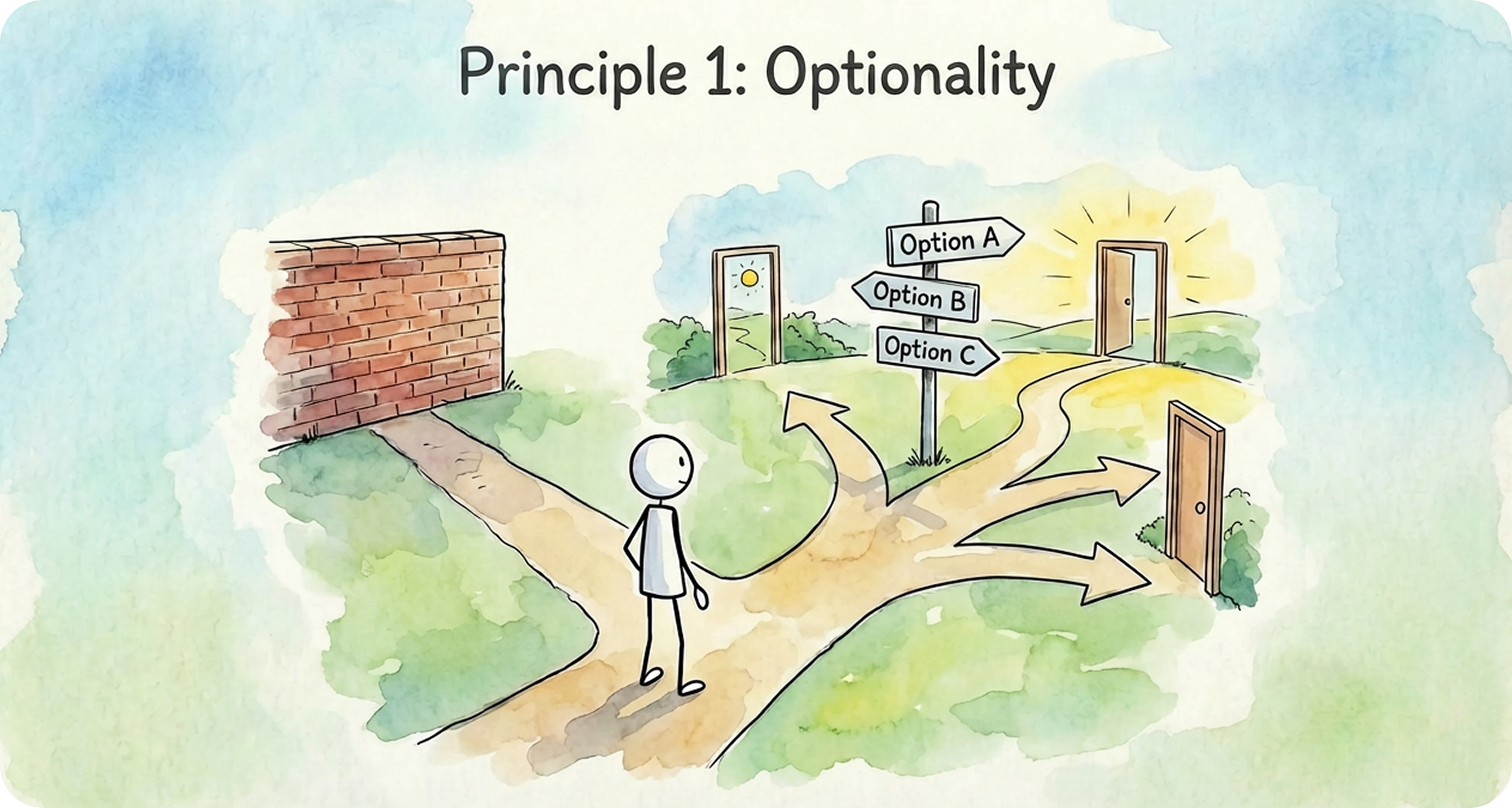
Their mistake was a lack of optionality.
They had bet everything on a single outcome. They traded survival for efficiency. And when the world shifted by a single degree, they had no Plan B, no genetic variance, and no exit ramp.
You’re reading this because you might feel a little bit like a Lumper farmer.
You’ve likely spent years optimizing yourself for a specific environment. You learned a specific software stack, mastered a specific corporate ladder, and memorized the rules of a specific industry. You’re highly efficient.
But deep down, you know that a shift is coming — an AI model, a recession, a strategic pivot — and you suspect that your efficiency has made you fragile.
The Prediction Trap
We’re taught from a young age that success is a function of planning.
In school, you pick a major to get a job. In corporate life, you build a five-year roadmap to hit a KPI. The assumption underlying all of this is that if you’re smart enough and work hard enough, you can predict what the world will look like in five years and build a straight path to it.
This works in a “Pin Factory” world where tomorrow looks exactly like yesterday. But in a chaotic world, reliance on prediction is dangerous.
In fact, the history of prediction is mostly a history of people who were very smart and very wrong.
In 1903, the New York Times predicted that flying machines would take one to ten million years to develop. The Wright Brothers flew nine weeks later.
Or consider something closer to home.
In 2023, “prompt engineer” was breathlessly called the job of the future. Six-figure salaries. The skill that would make you irreplaceable in the AI economy.
Eighteen months later, the models had improved enough that the elaborate prompting techniques became largely unnecessary.
The people who had learned the syntax of a moment found their expertise evaporating. The people who had learned the deeper skills — clear thinking, structured communication, understanding what problems actually needed solving — simply adapted and moved on.
Tools change. Principles endure.
This is where Nassim Taleb’s insight changes everything. He argues that if you have optionality, you don’t need to be smart.
If you “have optionality,” you don’t have much need for what is commonly called intelligence, knowledge, insight, skills, and these complicated things that take place in our brain cells. For you don’t have to be right that often.
This is a profound relief.
It means you can stop trying to outsmart the algorithm. You can stop trying to predict the future. Instead of trying to be right, you structure your life so that it doesn’t matter if you are wrong.
What Optionality Actually Is
In finance, an “option” is a contract that gives you the right, but not the obligation, to take an action.
If you buy a stock option and the stock crashes, you don’t have to buy it. You just walk away. Your loss is capped. But if the stock skyrockets? You exercise the option. Your upside is unlimited.
Optionality is the art of constructing a life with capped downside and unlimited upside.
Think of it as collecting lottery tickets where the tickets are free, but the payout is rare.
Steve Jobs took a calligraphy class in college. It had no practical application. It didn’t help him get a job. It was inefficient. But ten years later, when he was designing the Macintosh, that “useless” knowledge became the foundation for beautiful typography in personal computing.
He didn’t predict it. He held the option, and when the environment shifted, he cashed it in.
In a career context, optionality means having multiple paths to victory.
It means you’re never forced to do something you don’t want to do. You’re never forced to stay in a bad situation because you have no alternatives. You’re never unemployable because your entire skill set vanished overnight.
The person with optionality looks at a chaotic event — a layoff, a re-org, a new technology — and says, “Interesting.”
The person without optionality looks at the same event and says, “F*ck!”
The difference isn’t intelligence or talent. It’s whether you built escape routes before you needed them.
How to Build Optionality
You don’t build optionality by quitting your job and wandering the earth. You build it by collecting assets that serve as “exit ramps” from a dying career path.
Here are four specific ideas that I found useful.
1. Stack Skills That Multiply
Scott Adams, the Dilbert creator, has a theory about career success.
He says he’s not the best artist in the world. He’s not the funniest writer. He’s not the best at understanding office politics. But he’s pretty good at all three. And the intersection of those three things — someone who can draw, write jokes, and understand corporate absurdity — is vanishingly rare.5
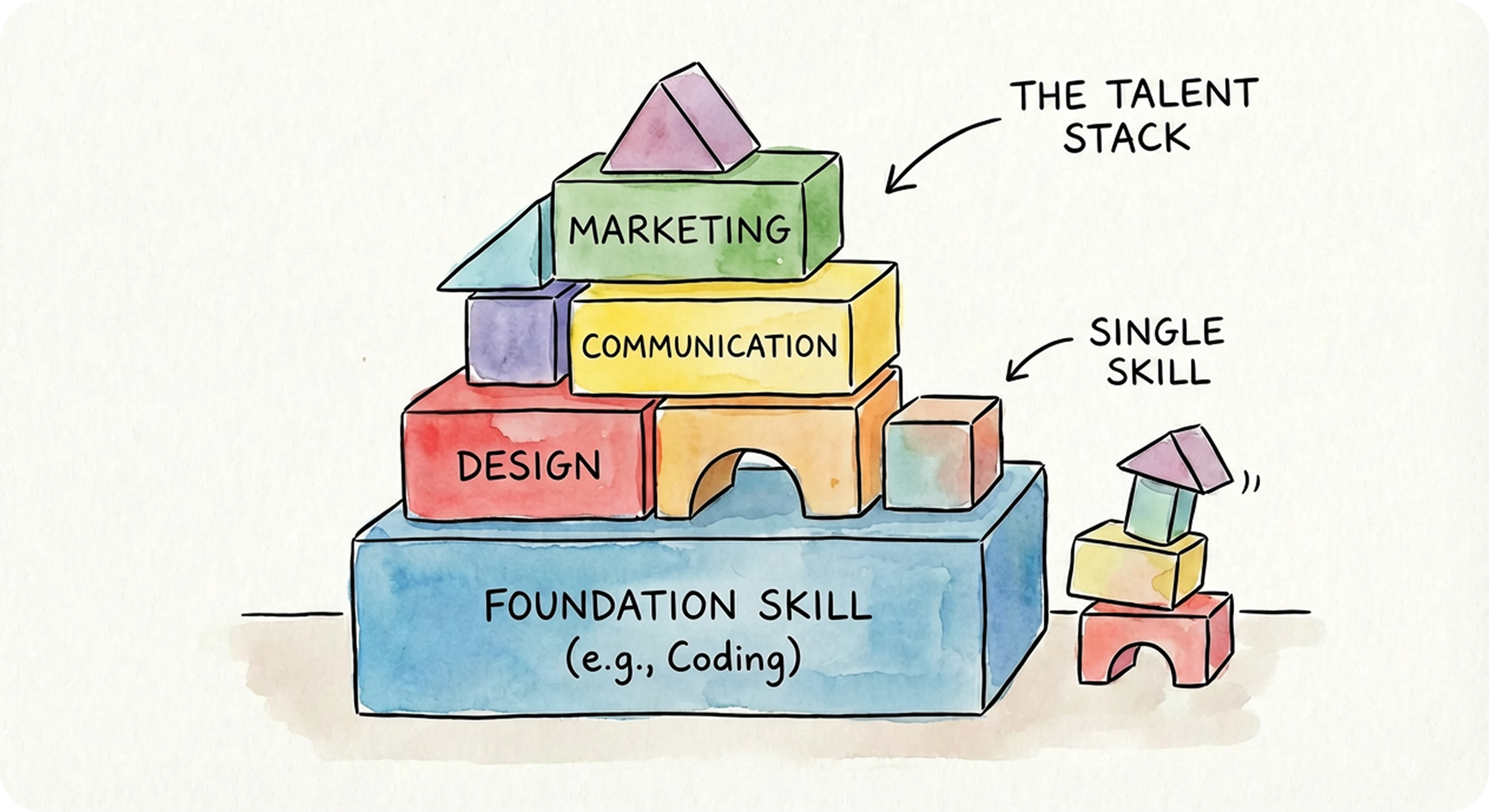
This is the math of skill stacking: skills don’t add, they multiply.
One skill gives you one path forward. Two unrelated skills create combinations you couldn’t have predicted. Three or four skills? The number of potential moves you can make starts to look exponential.
Think of it like a combination of Lego blocks.
If you only have red 2x4 bricks (design skills), you can only build a red wall. But if you add a few blue bricks (code), yellow bricks (business psychology), orange bricks (communication and persuasion), the number of things you can build doesn’t go up linearly — it explodes exponentially.
Each new skill doesn’t just add to the pile. It multiplies against everything already there.
The uncomfortable truth is that the person with four mediocre-to-good skills is often more valuable than the person with one exceptional skill. Not because excellence doesn’t matter — it does — but because most real-world problems don’t fit neatly into single-skill boxes.
The key insight here is that you shouldn’t collect skills randomly. It’s that you should stack skills that ideally complement each other — that create combinations greater than their parts.
The magic lives in the overlap.
2. Focus on What Doesn’t Change
Along the same lines, David Epstein’s book Range makes a case that generalists often outperform specialists in complex environments.6
In what Epstein calls “kind” learning environments — chess, golf, classical music — the rules are clear, feedback is immediate, and practice makes perfect. Here, specialists dominate.
But most careers exist in “wicked” learning environments. The rules are unclear. Feedback is delayed or misleading. What worked yesterday might not work tomorrow.
In wicked environments, the advantage goes to people who can draw from multiple domains. They’ve seen enough different situations to recognize patterns across boundaries. They adapt instead of breaking.
This creates an interesting question: What should you learn?
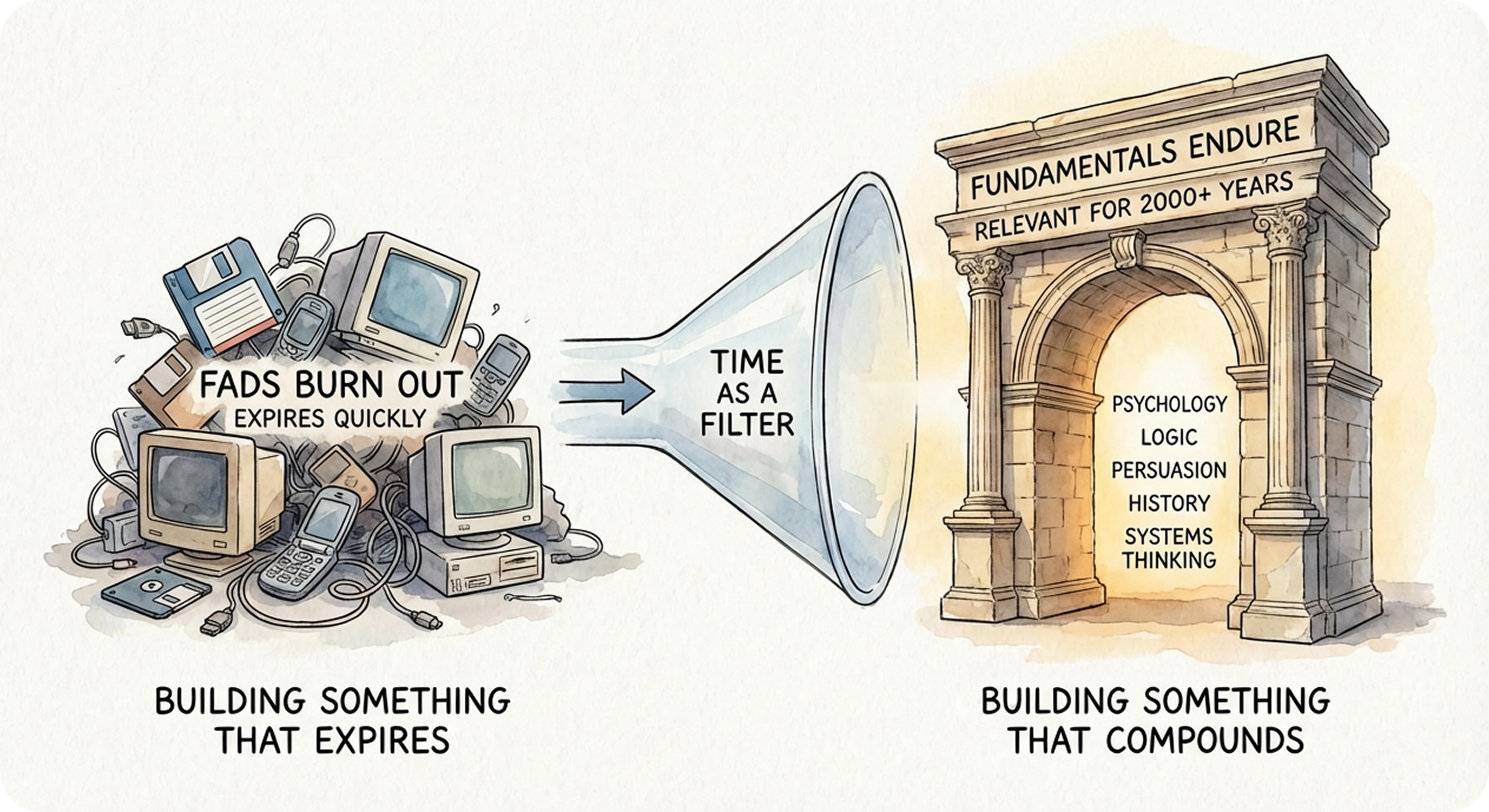
The Lindy Effect* offers a useful filter. Things that have been around for a long time are likely to stick around for a long time.7
Fads burn out. Fundamentals endure.
Low optionality: Learning the syntax of a specific tool (e.g., Salesforce, Jira, the mechanics of a particular software platform). These change every 18 months.
High optionality: Understanding how people make decisions under uncertainty. Learning psychology, persuasion, logic, history, and systems thinking. These have been relevant for 2,000 years and will be relevant for 2000 more. They transfer to every domain humans touch.
When you’re deciding what to learn, ask yourself: “If my industry vanished tomorrow, would this knowledge still be useful?”
If yes, you’re building something that compounds. If no, you’re building something that expires.
* We’ll dedicate Chapter 9 entirely to this concept.
3. Escape the Echo Chamber
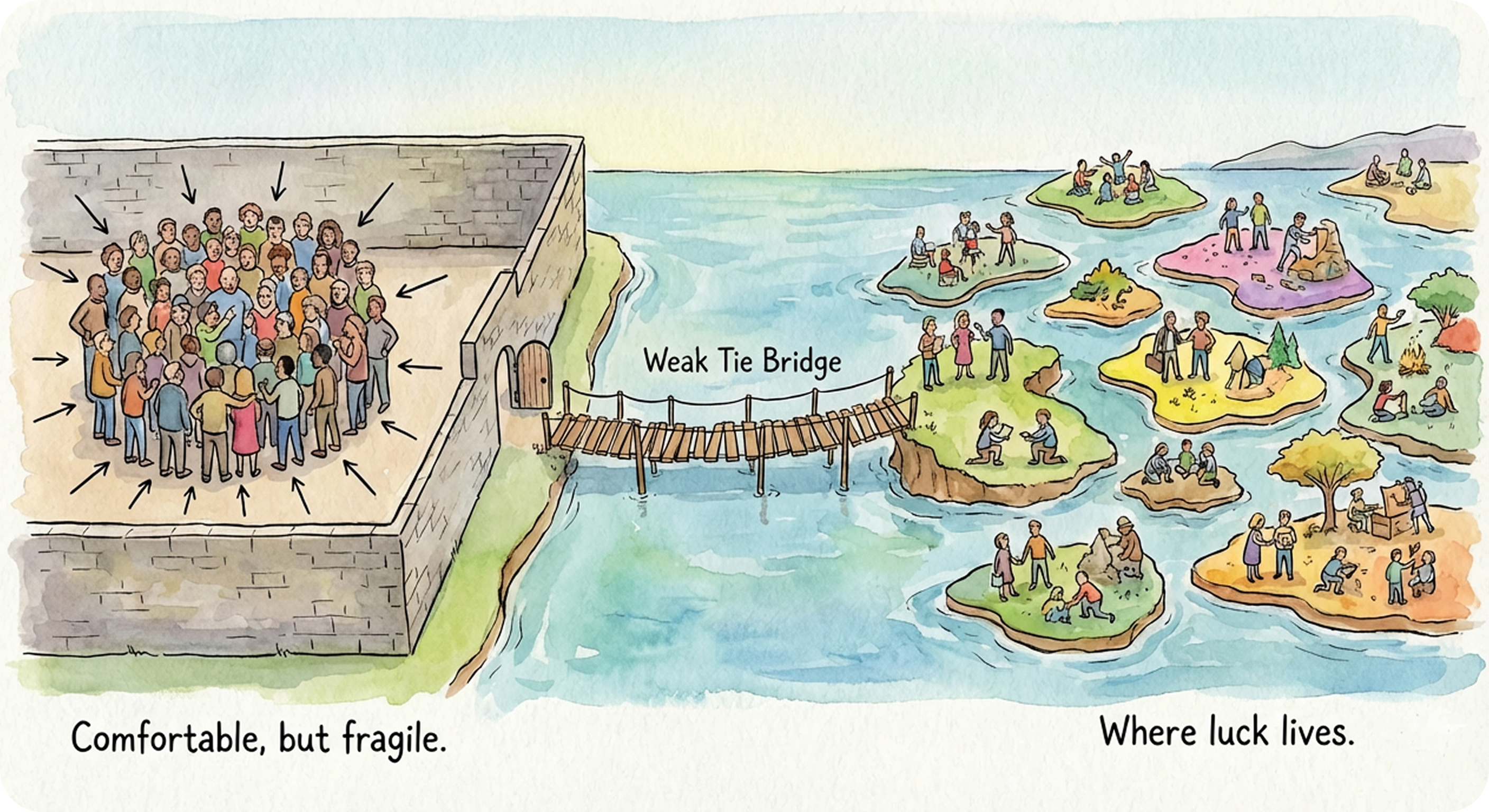
There is a natural human instinct to seek out people who’re exactly like us.
If you’re a writer, you want to hang out with writers. If you’re an engineer, you feel safest around other engineers. It’s comfortable. It validates your worldview. It creates a shared language.
It also creates a massive hidden risk.
If you’re a Product Manager and you know 50 other Product Managers, you don’t have a network. You have a mirror.
This feels efficient because you can skip the small talk and get straight to the jargon. But in a survival scenario, redundancy is fatal. If the tech market crashes, everyone in your circle is drowning at the same time, fighting for the same life rafts, holding the same depreciating assets.
True optionality comes from non-redundant information.
In the 1970s, sociologist Mark Granovetter made a counter-intuitive discovery called “the strength of weak ties.”8
He found that people rarely find new jobs or big opportunities through their close friends. Why? Because your close friends know everything you know. They read the same books, live in the same bubbles, and have the same blind spots.
Opportunity comes from the edge. It comes from the “weak tie” — the acquaintance, the former colleague, the person you met once at a dinner party who works in an industry you don’t understand. It comes from the edge because that is where the information arbitrage is.
The designer argues with other designers about pixels and processes.
The designer who talks to a founder in agriculture realizes the entire farming industry is desperate for better interfaces.
One is a commodity; the other is a revelation.
So, forget the word “networking.” It implies a transactional game of collecting business cards in hotel ballrooms. Nobody likes that, and it rarely works. Instead, think about breaking your own echo chamber.
Structure your relationships like a barbell*:
The core: A few deep relationships with peers who sharpen your craft.
The edge: A wide, messy collection of acquaintances who have nothing to do with your day job. Plumbers, financiers, biologists, mechanics, etc.
You don’t need to “work the room.” You just need to be curious about worlds that are not your own. Comfort comes from similarity. But luck? Luck lives in the gap between what you know and what someone else knows.
* This “barbell” approach is a concept we’ll explore in depth in the next chapter:

4. Develop Your Autonomy Capital
Finally, we must talk about the fuel that powers this engine: Money.
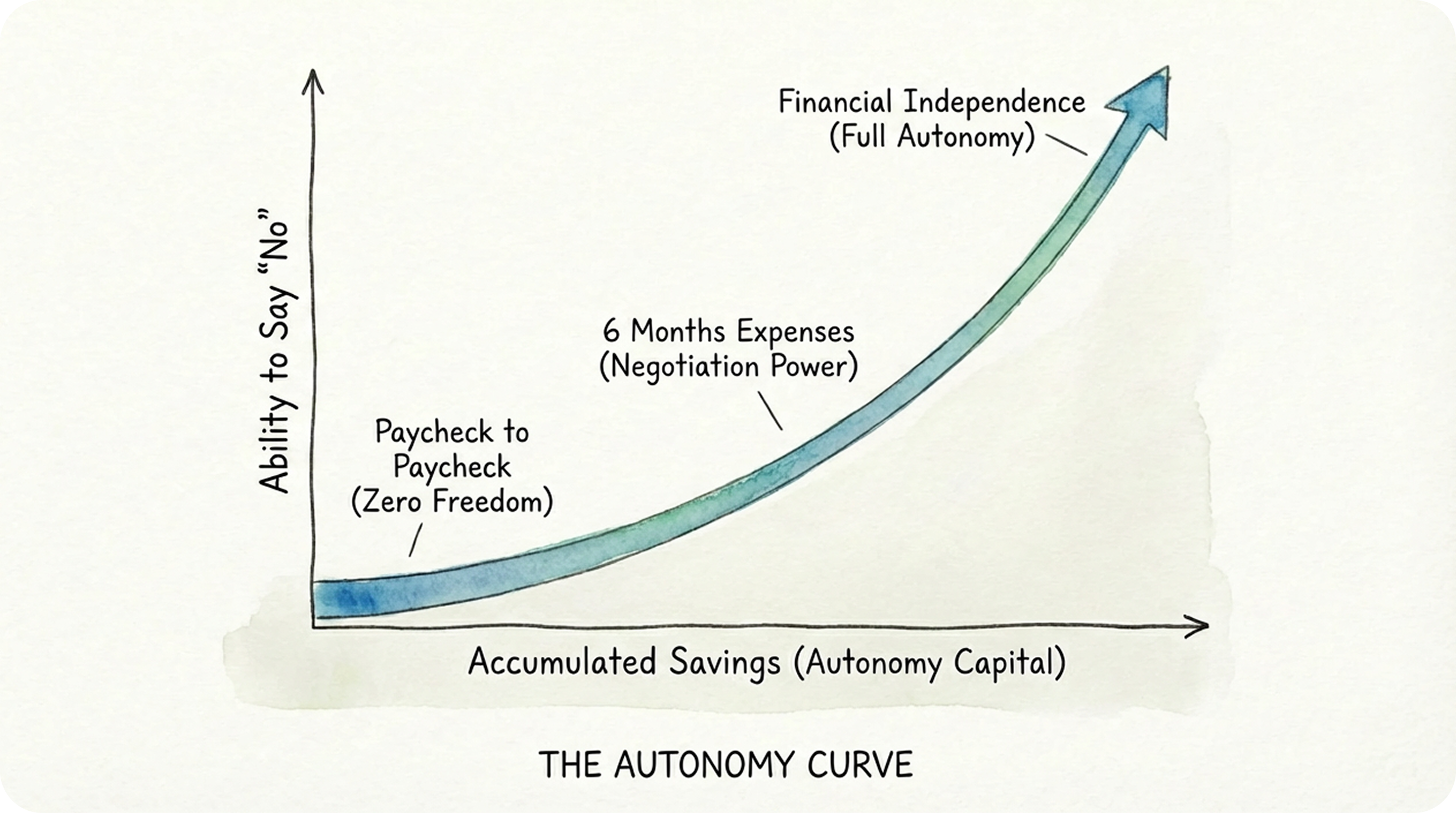
You cannot have mental optionality if you’re terrified of missing a rent payment. If you live paycheck to paycheck, you must accept the first job offered. You must tolerate the unreasonable boss. You must take the path of least resistance because there’s no margin for anything else.
Morgan Housel wrote that “the highest form of wealth is the ability to wake up every morning and say, ‘I can do whatever I want today’”.9
This doesn’t require millions of dollars. It requires living below your means consistently enough to build a buffer.
Six months of expenses in the bank changes how you negotiate. It changes how you speak in meetings. It lets you walk away from situations that erode your dignity. It allows you to wait for the right opportunity rather than the next opportunity. Savings are your Autonomy Capital.
Debt works in the opposite direction.
A large mortgage, expensive taste, a lifestyle that requires the maximum possible income — these are all forms of negative optionality. They eliminate your ability to say no.
The cruel irony is that the higher your spending rises, the more you depend on income. The more you depend on income, the more you must optimize for it. The more you optimize, the more fragile you become.
Keeping your overhead low allows you to take risks that well-paid but overextended people cannot afford.
Implementation Guide
Look at your last 3 months of work:
The Tool test: If your favorite software tool disappeared tomorrow, how much of your expertise would vanish with it?
The Evidence test: If a stranger Googled you, would they find proof of your skills (articles, projects, code), or just a list of job titles?
The Fragility test: What percentage of your learning time was spent on things that only apply to your current job title? (If it’s >90%, you’re fragile).
The Pivot test: If your industry vanished tomorrow, could you be hired in a different role within 3 months based on your current skills?
The Action Plan
Stack a skill: Identify a skill that is complementary but distinct from your main job. Dedicate 2 hours a week to it and learn the fundamentals.
Diversify your feed: Unfollow 10 industry thought leaders. Follow 10 people from completely different fields. Architecture, history, science, design. Once a month, have coffee with someone who has no idea what your job title means. Learn what their problems are.
Create evidence: Stop polishing your resume. Build one small thing and publish it publicly this month. A tool you coded. A guide you wrote. A process you documented. A problem you solved. Then share it. Not because you’re trying to go viral. Because you’re creating proof. When the next wave comes — and it will — the person with a portfolio of proof adapts. The person with just a job title doesn’t.
The question isn’t “What should I specialize in?” The question is “What portfolio of options am I building so that when everything changes, I have somewhere to go?”
What’s Next: The Barbell Strategy
After learning about optionality, here’s a question that might be nagging at you:
How do you actually structure your time and energy?
How much risk should you take?
When do you play it safe, and when do you swing for the fences?
Most advice tells you to find the balance. The sweet spot. The sensible middle ground.
But in the next chapter I’ll introduce a strategy that sounds reckless until you understand the math — and then it sounds like the only sane approach. It’s called the Barbell Strategy, and it suggests that the safest position isn’t in the middle at all. It’s at both extremes simultaneously.
Division of Labor: Adam Smith’s observation of the pin factory serves as the foundational text for modern professional specialization. See: Smith, A. (1776). An Inquiry into the Nature and Causes of the Wealth of Nations.
Evolutionary Fragility: Evolutionary biology illustrates that over-specialization often leads to extinction events when environmental conditions change rapidly. See: Gould, S. J. (1980). The Panda’s Thumb: More Reflections in Natural History. W. W. Norton & Company.
Antifragility: Nassim Taleb defines optionality and argues that complex systems (like the immune system or a career) weaken and die when deprived of stressors. See: Taleb, N. N. (2012). Antifragile: Things That Gain from Disorder. Random House.
The Irish Potato Famine: For historical context on the monoculture of the “Lumper” potato and how hyper-optimization led to the Great Famine, see: Pollock, C. (2003). The Irish Potato Famine: The Story of the Great Hunger. The History Place.
Skill Stacking: Scott Adams argues that combining mediocre skills (drawing + humor + business) creates a unique monopoly, often more valuable than being the best at one thing. See: Adams, S. (2013). How to Fail at Almost Everything and Still Win Big. Portfolio.
The Generalist Advantage: David Epstein provides evidence that in “wicked” learning environments, generalists defeat specialists because they can draw from a wider array of mental models. See: Epstein, D. (2019). Range: Why Generalists Triumph in a Specialized World. Riverhead Books.
The Lindy Effect: Benoit Mandelbrot formalized the concept that for non-perishable things (like ideas or books), the expected future life span increases with every day it survives. See: Mandelbrot, B. (1982). The Fractal Geometry of Nature. W.H. Freeman.
The Strength of Weak Ties: Mark Granovetter’s seminal sociological study found that new opportunities usually come from acquaintances (weak ties) rather than close friends (strong ties). See: Granovetter, M. S. (1973). The Strength of Weak Ties. American Journal of Sociology.
The Highest Dividend: Morgan Housel argues that the greatest value of money is not buying things, but buying control over your time. See: Housel, M. (2020). The Psychology of Money. Harriman House.
Loved your examples Daniel - Steve Jobs is the quintessential one and the lumper potato was a new one! Framing it as building optionality is a good lens - minimizing downside and leaving space for unlimited upside.
I naturally followed multiple paths and pursuits in my life, which I really enriched my understanding and contribution to the world. But I agree that now in this new AI age that we are entering, this should be the norm!